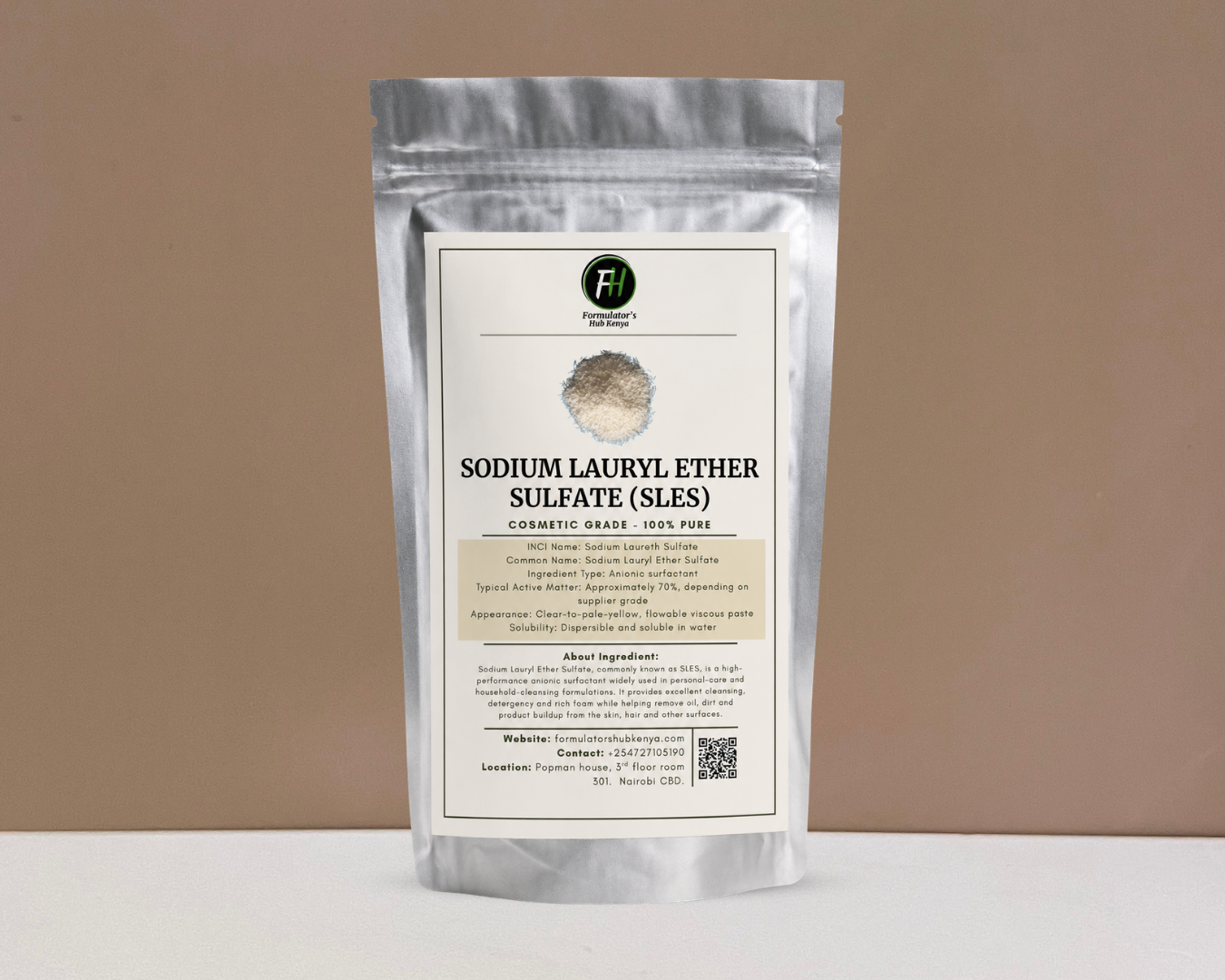
Sodium Lauryl Ether Sulfate (SLES)
Sodium Lauryl Ether Sulfate (SLES)
Couldn't load pickup availability
INCI Name: Sodium Laureth Sulfate
Common Name: Sodium Lauryl Ether Sulfate
Ingredient Type: Anionic surfactant
Typical Active Matter: Approximately 70%, depending on supplier grade
Appearance: Clear-to-pale-yellow, flowable viscous paste
Solubility: Dispersible and soluble in water
Product Description
Sodium Lauryl Ether Sulfate, commonly known as SLES, is a high-performance anionic surfactant widely used in personal-care and household-cleansing formulations. It provides excellent cleansing, detergency and rich foam while helping remove oil, dirt and product buildup from the skin, hair and other surfaces.
SLES 70% is supplied as a concentrated, flowable paste. It is suitable for producing clear or pearlized cleansing products and can be thickened effectively using sodium chloride when incorporated correctly. Commercial SLES grades are commonly used as primary surfactants in shampoos, shower gels, bubble baths, liquid soaps, dishwashing liquids and household detergents.
Key Benefits
* Produces rich, stable and abundant foam.
* Provides effective cleansing and degreasing.
* Offers good wetting and emulsifying properties.
* Compatible with many amphoteric and non-ionic co-surfactants.
* Can be thickened using sodium chloride.
* Suitable for clear, opaque and pearlized formulations.
* Concentrated grade helps reduce the amount of water introduced through raw materials.
Recommended Applications
SLES may be used in:
* Shampoos and 2-in-1 shampoos
* Body washes and shower gels
* Facial and hand cleansers
* Liquid hand soaps
* Bubble baths
* Dishwashing liquids
* Laundry detergents
* Car-wash products
* Multipurpose and hard-surface cleaners
Suggested Usage Rate
The required amount depends on the active concentration of the supplied grade, desired foam level and total surfactant system. A BASF shampoo-formulation example lists Sodium Laureth Sulfate at approximately 7–15%, but each formulation should be tested and adjusted according to the intended product.
Formulation Guidelines
Slowly add SLES to water while stirring gently to minimise excessive foaming. Concentrated SLES may temporarily form a thick gel during dilution; viscosity normally decreases once the active concentration is reduced sufficiently. BASF advises either using an appropriate salt-solution incorporation process or dissolving the material with warm water at approximately 80°C when direct cold dilution is difficult.
For milder cleansing systems, combine SLES with co-surfactants such as Cocamidopropyl Betaine, glucosides or other mild surfactants. Add sodium chloride gradually near the end of production because excessive salt can reduce viscosity after the formulation reaches its maximum thickness.
Storage
Store tightly closed in a cool, dry and well-ventilated area. Protect from contamination, excessive heat and prolonged exposure to very low temperatures. Mix carefully if separation or uneven consistency occurs after storage.
Safety Precautions
This is a concentrated raw material intended for formulation use and should not be applied directly to the skin. Wear gloves and protective eyewear during handling. Concentrated 70% SLES grades may cause skin irritation and serious eye damage; rinse immediately with plenty of water following accidental contact and consult the supplier’s Safety Data Sheet.
For external-use and professional formulation purposes only.

Sodium Lauryl Ether Sulfate (SLES)
Prev/Next products
 ecomgraduates.product.prev_product
 ecomgraduates.product.next_product